Screws and fixings for gypsum board: lengths, spacing and fixing mistakes
A guide to drywall screws and fixings: screw length for each thickness, spacing on ceilings and walls, the right depth, and anchors for concrete and cavities.
Arkan Almajara team · · 2 min read
The short answer
A drywall screw must penetrate the steel channel enough, sit just below the paper surface without tearing it, and be spaced as the manufacturer sets, closer on ceilings than walls. A screw driven too deep or left proud is where popping and cracks begin.
- Screw length = total board thickness + enough penetration into the steel.
- Spacing is closer on ceilings than walls, and closer at edges than in the field.
- The screw head sits just below the surface without tearing the paper.
- Anchors for hangers in concrete are chosen to carry the ceiling, not whatever is to hand.
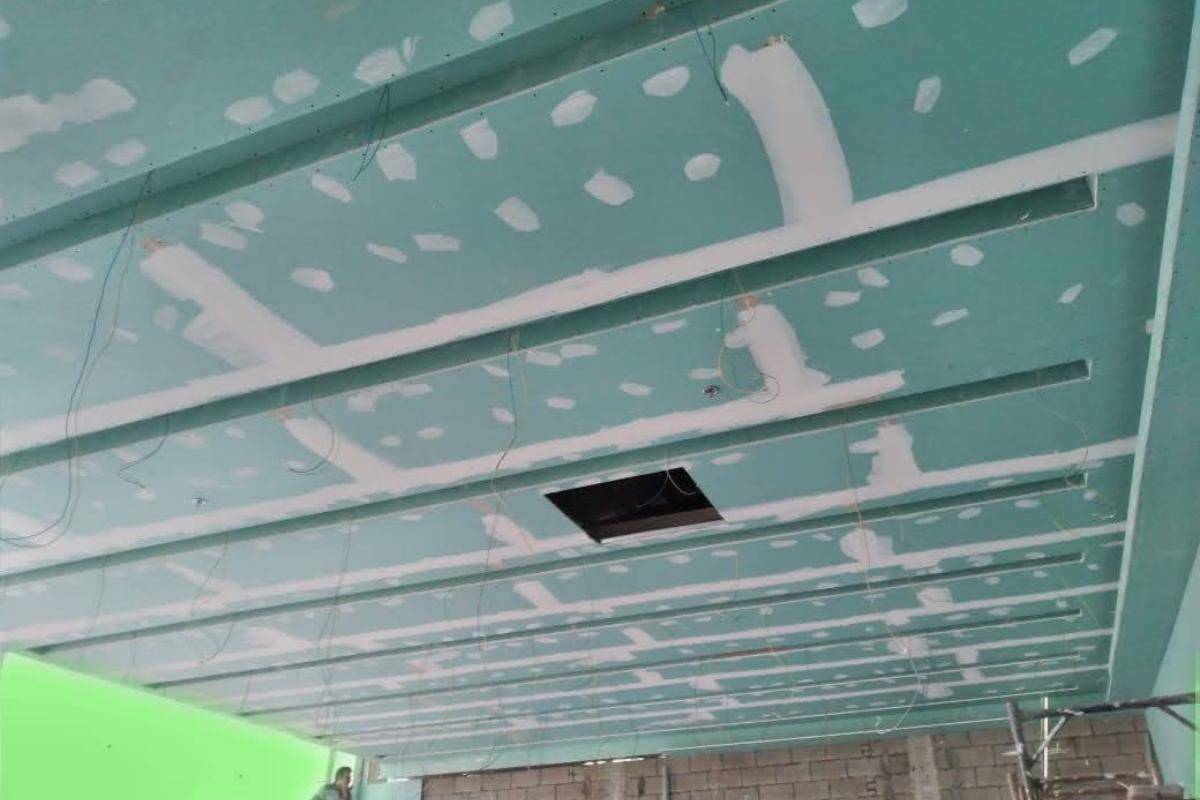
A small detail, but the thousands of screws in one ceiling decide whether the surface stays calm or shows dots and pops after a few months.
Choosing the screw
- Type: a bugle-head drywall screw, self-drilling for thicker channels or sharp-point for light-gauge steel, per supplier.
- Length: long enough to pass through all board layers and penetrate the channel properly. One 12.5 mm board needs a shorter screw than two layers.
- Protection: corrosion-resistant, especially in wet areas and coastal cities.
Spacing
The reference is the manufacturer’s instructions. As a general rule:
| Location | Common spacing |
|---|---|
| Ceilings (along each furring channel) | Closer, often about 150–200 mm |
| Walls (along each stud) | Wider, often about 250 mm |
| From the board edge | About 10–15 mm; no closer, or the edge breaks |
Ceilings need denser fixing because gravity pulls the board away from the channel all the time.
The right depth
The screw head should sit just below the paper surface so compound covers it, without tearing the paper. A screw that tears the paper does not hold: the gypsum beneath crumbles. The answer is an extra screw beside it, not a deeper one.
We use screwdrivers with a depth stop that sets this automatically.
Fixing to concrete
Hangers and wall angles are fixed to concrete with purpose-made anchors, metal ones for ceilings, because they carry the whole ceiling’s weight. We do not use plastic plugs to hang ceilings.
Common mistakes
- Too few screws to work faster, so the board waves between points.
- Screws too close to the edge, which breaks.
- Fixing a board without pulling it tight to the channel, leaving a gap that moves.
- Rusty or unsuitable screws in a wet area.
Read jointing and the suspended ceiling frame. The service: gypsum board.
Frequently asked questions
Why do screw heads show after painting?
Because they were not set deep enough, were not covered with two or three coats of compound, or the screw moves because the board was not pulled tight to the channel.
Can wood screws be used?
No. Drywall screws have a bugle head that does not tear the paper, a point suited to steel channels, and a corrosion-resistant coating.